
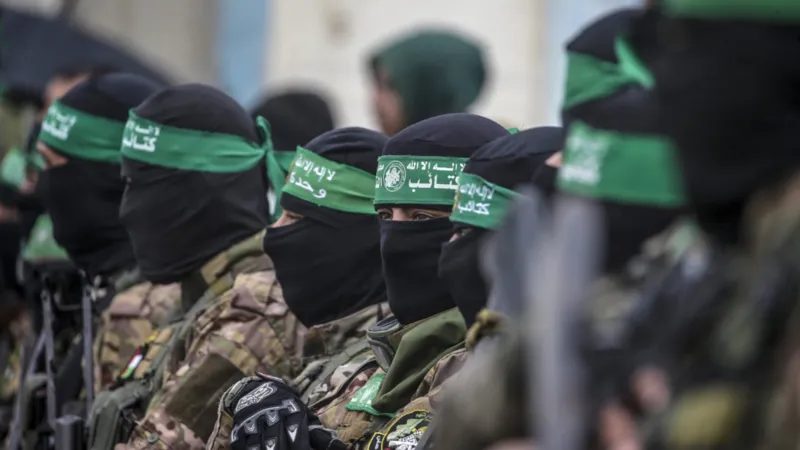
The Palestinian militant group Hamas has categorically rejected demands to disarm unless a fully sovereign Palestinian state, with Jerusalem as its capital, is established. This stance directly counters a critical Israeli condition for a ceasefire in the ongoing Gaza conflict.
The statement, issued by Hamas over the weekend, was a pointed response to comments attributed to U.S. Special Envoy to the Middle East, Steve Witkoff, who allegedly suggested that Hamas had signaled readiness to lay down its arms. Hamas firmly denied this claim, calling it misleading and reiterating that its armed resistance would persist until legitimate statehood is achieved.
“Resistance and its weapons are a sacred right,” the group stated, insisting that disarmament is non-negotiable without the realization of full Palestinian sovereignty.
Ceasefire Talks in Crisis
Indirect ceasefire negotiations between Israel and Hamas, which also involve discussions on the release of Israeli hostages, have reached an impasse. Efforts mediated by international actors have faltered in recent weeks, with both sides hardening their positions.
The Israeli Defense Forces (IDF) Chief of Staff, Lt. Gen. Eyal Zamir, declared on Friday that military operations in Gaza would continue unabated unless swift progress is made on securing the hostages’ release.
A particularly distressing development emerged when Hamas released a video showing Israeli hostage Evyatar David, appearing severely malnourished and disoriented in a dimly lit tunnel. His family condemned the footage as psychological warfare and pleaded with both the Israeli government and the U.S. administration to intensify rescue efforts.
Diplomatic Pressure Mounts
The Hamas declaration comes amid renewed diplomatic momentum in the region. Several Western nations, including France and Canada, have recently voiced support for recognizing a Palestinian state — a move that has stirred considerable geopolitical debate. The United Kingdom has also stated it may recognize Palestine if Israel fails to meet certain conditions by September.
Arab governments, under increasing international scrutiny, have called on Hamas to disarm and relinquish control of the Gaza Strip, in a bid to stabilize the region and pave the way for formal state recognition.
Humanitarian Crisis Deepens
Steve Witkoff’s visit to Israel has brought renewed focus to the worsening humanitarian conditions in Gaza. During his visit, he met with Israeli Prime Minister Benjamin Netanyahu and inspected controversial aid distribution points in southern Gaza that have become flashpoints for violence and desperation.
The United Nations reports that over 1,370 Palestinians have been killed while seeking food since late May. These figures include numerous casualties near Gaza Humanitarian Foundation (GHF) distribution centers, where Israeli troops have clashed with crowds. While the Israeli military accuses Hamas of inciting chaos at these sites, it denies intentionally targeting civilians.
Witkoff, who also met with families of Israeli hostages in Tel Aviv, emphasized that peace efforts should prioritize a comprehensive resolution, not piecemeal agreements.
Devastation from Protracted Conflict
The current conflict stems from the October 7, 2023, Hamas-led attack on southern Israel, which resulted in the deaths of approximately 1,200 people and the abduction of 251 hostages. In response, Israel launched a wide-scale military campaign in Gaza.
Since then, more than 60,000 people have reportedly been killed in the enclave, according to figures from Gaza’s Hamas-run health ministry. Among them are at least 169 individuals — including 93 children — who are said to have died due to malnutrition.
The escalating death toll, deepening humanitarian catastrophe, and stalled negotiations continue to draw international condemnation and urgency for a sustainable diplomatic resolution.
Source – My News Ghana
About the Author