
The Economic and Organised Crime Office (EOCO), working in close collaboration with Interpol, the Federal Bureau of Investigation (FBI), and the Royal Canadian Mounted Police (RCMP), has successfully recovered more than 100 stolen luxury vehicles trafficked into Ghana.
The agency is currently investigating an additional 300 suspected stolen vehicles, as part of a major crackdown on international car trafficking networks.
EOCO issues public warning
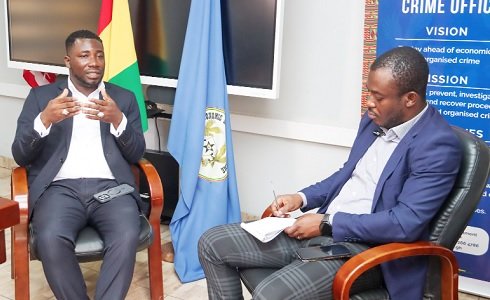
Speaking exclusively to Graphic Online, the Head of Legal and Prosecutions at EOCO, Mr. Leo Antony Siamah, cautioned the public to exercise maximum vigilance when purchasing vehicles, especially high-end brands.
According to him, unscrupulous syndicates often pose as legitimate dealers, while others even impersonate EOCO officials to seize cars under false pretenses.
“Some individuals are parading as EOCO officers to unlawfully seize vehicles. We urge the public to always verify the identity of anyone claiming to be from EOCO before cooperating with them,” Mr. Siamah stressed.
How stolen cars end up in Ghana
Explaining the modus operandi, Mr. Siamah revealed that most vehicles are stolen from unsuspecting owners in the United States and Canada—often when victims are out of town. The vehicles are then shipped into Ghana using forged documentation.
By the time the vehicles are flagged as stolen abroad, they are already in the hands of unsuspecting Ghanaian buyers.
Despite EOCO’s ongoing collaboration with the Ghana Revenue Authority (GRA), port authorities, and security agencies to tighten verification systems, Mr. Siamah noted that the ultimate responsibility lies with buyers.
“The law requires every buyer to do due diligence. If you fail to verify and later discover the car is stolen, you have no legal remedy, because someone else is also waiting for their stolen car,” he explained.
High-risk car brands trafficked into Ghana
EOCO identified some of the most commonly trafficked luxury vehicles as:
-
Mercedes-Benz
-
Bentley
-
Lexus
-
Rolls-Royce
-
BMW X7 & X8 series
-
Ford F-150
-
Cadillac Escalade
-
Dodge Ram
-
Honda CR-V
Red flags to look out for
EOCO urged potential buyers to watch out for these warning signs:
-
Suspiciously low prices compared to market value.
-
Incomplete, missing, or altered documents.
-
Tampered Vehicle Identification Numbers (VINs) – always cross-check VINs on the dashboard, door jamb, and engine compartment.
-
Missing or altered rear-view mirrors – a common hiding spot for GPS trackers.
Buyers are also encouraged to use online platforms such as Carfax, AutoCheck, and the National Insurance Crime Bureau (NICB) to verify a car’s history.
For final confirmation, the public can contact EOCO directly at 0547419419.
Protecting Ghana’s reputation
Mr. Siamah dismissed claims that EOCO’s operations were arbitrary, insisting the agency was only executing its mandate under the law. He called for stronger collaboration between EOCO, car dealers, garage owners, and the general public to clamp down on the trade.
“This issue damages Ghana’s image as it portrays the country as a hub for stolen vehicles. Even genuine buyers end up being stigmatized when driving these cars,” he said.
Recovering proceeds of crime
EOCO also reaffirmed its commitment to making crime unattractive by seizing and recovering proceeds of crime, as mandated under the Economic and Organised Crime Office Act, 2010 (Act 804).
This includes investigating offences such as money laundering, tax fraud, human trafficking, cybercrime, and financial loss to the state.
However, Mr. Siamah admitted that challenges such as complex asset ownership structures and cross-border operations sometimes hinder their work. He urged the public to collaborate more with EOCO to help strengthen investigations.
Regional context
West Africa has long been flagged as a hotspot for stolen vehicles. In April 2025, an Interpol-led operation across 12 West African countries, including Ghana, resulted in the detection of 150 stolen luxury cars and the seizure of more than 75 vehicles.
Source: My News Ghana
About the Author