
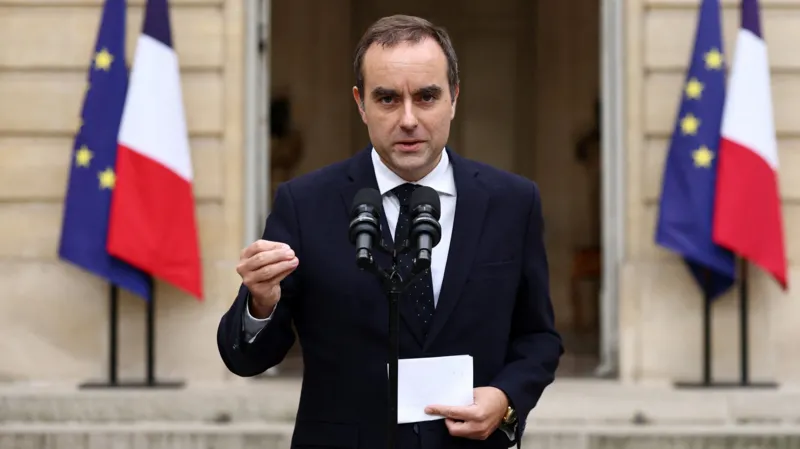
France has been thrown into fresh political uncertainty after Prime Minister Sébastien Lecornu abruptly resigned on Monday morning, less than 24 hours after unveiling his cabinet.
“The conditions were not fulfilled for me to carry on as prime minister,” Lecornu said in a brief statement outside the Hôtel de Matignon, sharply criticising France’s political class for its “unwillingness to compromise.”
The Élysée Palace confirmed the resignation following a one-hour meeting between Lecornu and President Emmanuel Macron. The announcement marks yet another setback for Macron, whose centrist government has struggled to maintain stability amid a fragmented National Assembly.
Lecornu’s departure comes just 26 days after his appointment, succeeding François Bayrou, whose government collapsed after parliament voted down his austerity budget. The new cabinet—largely unchanged from Bayrou’s—was immediately met with fierce opposition across the political spectrum, with parties threatening to vote it down.
In his resignation remarks, Lecornu lamented the “partisan appetites” and inflated egos dominating French politics.
“I was ready for compromise, but all parties wanted others to adopt their programmes in their entirety. It wouldn’t need much for this to work,” he said, urging political factions to “cast some egos aside.”
A Government in Perpetual Crisis
Lecornu, formerly Minister of the Armed Forces and a trusted Macron ally, was France’s fifth prime minister in under two years—a sign of the deep instability plaguing the French political landscape.
Since Macron’s decision in July 2024 to call snap parliamentary elections, France has been left with a hung parliament divided between far-left, centrist, and hard-right blocs, each unwilling to collaborate.
That paralysis has made it nearly impossible to pass major legislation, and successive governments—led by Michel Barnier and François Bayrou—have fallen in quick succession.
Mounting Pressure on Macron
The resignation reignites debates about Macron’s next move, with three options reportedly under consideration:
- Appoint another prime minister,
- Dissolve the National Assembly and call fresh elections, or
- Resign himself—though the last remains highly unlikely.
Analysts suggest a new legislative election is increasingly inevitable, even if it risks delivering a sweeping victory for Marine Le Pen’s far-right National Rally (RN).
Le Pen seized on the crisis to renew her call for Macron’s departure.
“The only wise thing to do now is to hold elections,” she said. “The joke’s gone on long enough. The French people are fed up.”
Economic and Market Fallout
The political chaos adds to France’s growing fiscal challenges. The country’s budget deficit stands at 5.8% of GDP, while national debt has climbed to 114% of GDP—one of the highest in the eurozone, behind only Greece and Italy.
Markets reacted swiftly to the news, with stocks on the Paris exchange tumbling sharply on Monday morning amid investor fears of prolonged instability.
As Macron weighs his options, France faces a daunting question: can the president salvage his final two years in office, or has Europe’s second-largest economy entered a new era of chronic political paralysis?
Source – My News Ghana
About the Author