

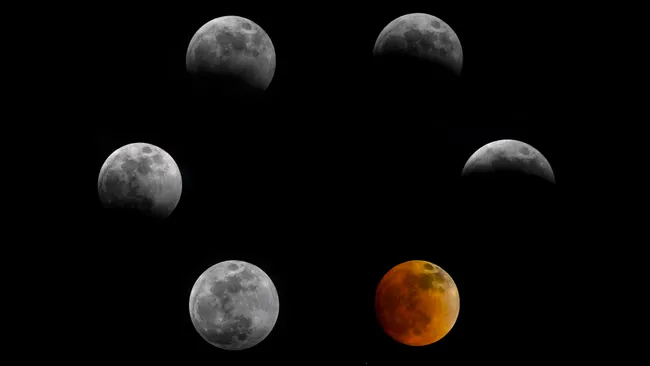
Skywatchers across much of the world are in for a breathtaking celestial show as a total lunar eclipse—popularly called a “blood moon”—unfolds on the nights of September 7 and 8, 2025.
The phenomenon will be visible to over 7 billion people across Asia, Australia, Africa, and eastern Europe.
Why the Moon Turns Red
A total lunar eclipse occurs when the Earth passes directly between the Sun and the Moon, casting its shadow across the lunar surface. Instead of going completely dark, the Moon takes on a deep reddish glow. This happens because Earth’s atmosphere bends and scatters sunlight, filtering out blue light while allowing the red hues of sunrises and sunsets around the globe to project onto the lunar disk.
Where and When to Watch
- Best Views: The eclipse will be seen in its entirety across Asia, western Australia, and eastern Europe.
- Partial Views: Some regions, including Spain and Norway, will only catch a partial eclipse.
- Timing: Observers should expect several phases, beginning with the penumbral shadow, followed by the partial eclipse, and climaxing with the total phase, when the Moon will glow its darkest red.
What Makes This Special
This blood moon is not just a spectacular sight—it’s also one of the most widely visible eclipses in recent years, offering billions of people the chance to witness the Moon transform dramatically without any special equipment.
Astronomers recommend finding a dark, open sky away from city lights for the clearest view. Binoculars or a small telescope will enhance the experience, but the blood moon is perfectly visible to the naked eye.
Source – My News Ghana
About the Author